
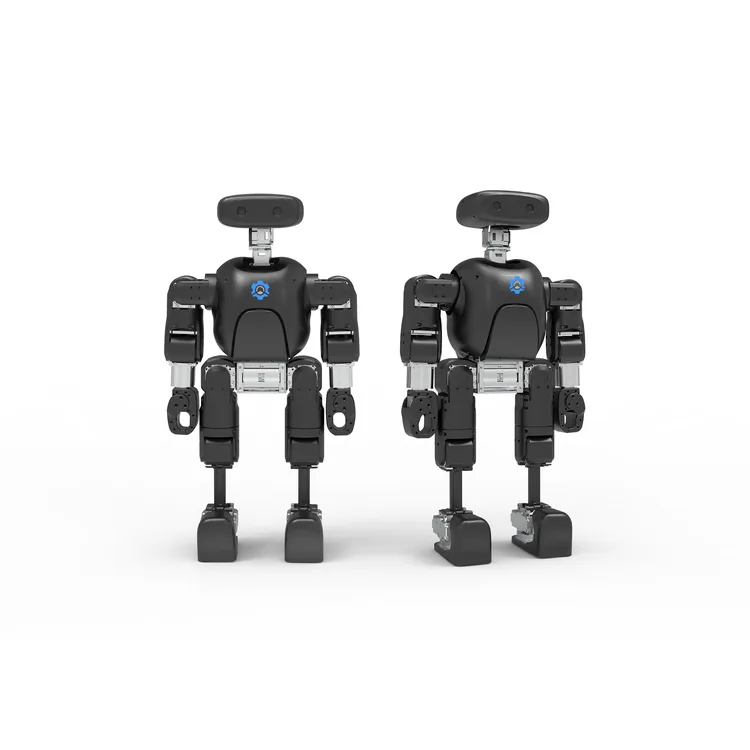
Mini Pi
A knee-high research humanoid from China that walks, jumps and runs your own code. It's built for labs, classrooms and robot competitions, and nobody independent has reviewed it yet.
We re-check daily. Try the manufacturer’s site meanwhile.
The short version
Mini Pi is a family of small walking robots from HighTorque, a Chinese company that also makes the motors inside them. The Mini Pi+ is the humanoid: about 65cm tall, around 10kg, with arms, a head and 22 motorised joints. The original Mini Pi is just a pair of legs and a body, 52cm tall. Both are meant for people who write robot software: university labs, teachers and competition teams. HighTorque opens up the controls so you can program how it walks and moves.
That's the trade-off. Out of the box, the Mini Pi+ has a few preset routines, such as dancing, kung fu and football, and a remote control. Anything more is up to you. It runs for about an hour per charge, by HighTorque's figures. It's sold worldwide from the maker's online shop, with no local dealers or support we could find, and no independent tests to show how well it holds up.
Our take: Consider a Mini Pi+ only if you or your students plan to write the robot's software, and you're comfortable buying direct from China without local support. It's not a home robot or a toy. If you'd rather have a small humanoid from a maker with more of a track record and published documentation, Unitree's R1 or Booster's K1 are the ones to compare.
Where it sits in HighTorque’s range
- Mini PiThis model
- Mini HiHighTorque's other small humanoid
- Mini Pi+ ProAdds a faster computer and a depth camera
What we know so far
Limited evidence No independent, finished hands-on review of this robot yet. What follows comes from the maker's specifications and early coverage, and says where something is untested.
We found no independent review of any Mini Pi, hands-on or otherwise. What's known comes from HighTorque itself: its product pages HighTorque Robotics, its online store HighTorque store and its own news posts about the robot at competitions HighTorque Robotics. Those describe a small, open research humanoid that can walk, jump and play football, but they're the maker's claims. Nobody outside the company has published how reliable it is, how long it really runs or how good the software is.
Made for people who code
HighTorque pitches the Mini Pi+ at research, teaching and robot competitions, with an open programming kit and modular hardware so labs can build their own walking, grasping and whole-body control HighTorque Robotics. The store version has a remote control and preset dance, kung fu and football routines HighTorque store. There's nothing about household tasks. If nobody in your group writes robot software, it will do very little.
Two quite different robots
The name covers two machines. The original Mini Pi has 12 joints, all in its legs, stands 52cm tall and weighs 7kg, per HighTorque Robotics. The Mini Pi+ adds arms and a head for 22 joints, and stands 65cm tall. Confusingly, HighTorque's own description mentions 26 joints while its specification tables say 22 HighTorque store. Check exactly which version and configuration you're being quoted for.
Specs to check before buying
HighTorque's spec sheet gives about an hour of running time at walking pace, a 5,000mAh battery and a top speed of 1.1m/s for the Mini Pi+ HighTorque store. The Pro version swaps in a more powerful computer and adds a depth camera. An optional gripper, waist joint and camera upgrade cost extra. All of this is the maker's own data, so ask for a demonstration or documentation before committing.
Buying from overseas
HighTorque's store prices in US dollars and lists shipping to the UK, Europe, the US and Australia HighTorque store. We found no local distributor or service centre. HighTorque's news pages show Mini Pi+ units at Chinese robot sports events HighTorque Robotics, but that's the maker showing off its own robot. Budget for import charges and assume repairs mean dealing with China directly.
No independent reviews found. Specs come from HighTorque's product pages and store, and mostly describe the Mini Pi+.
Prices
Where to buy the Mini Pi in Australia
No verified Australia price in the last 7 days. We re-check daily.
Before you buy
The questions people ask about this one
Can I actually buy one?
Yes, directly from HighTorque's online store, which ships worldwide and prices in US dollars HighTorque store. When we checked, the Mini Pi+ was listed as available and the legs-only Mini Pi was sold out. We found no local dealer in the UK, Europe, the US or Australia.
What can it do on its own today?
Very little without programming. The Mini Pi+ comes with preset dance, kung fu and football routines and a remote control HighTorque store. HighTorque says it can stand, walk and jump HighTorque Robotics. Everything else, from new movements to using its camera, depends on software you write.
What does it need to run?
A charged battery, which HighTorque rates at about an hour of walking, and its remote control HighTorque store. For development you'll need a computer and HighTorque's programming kit. The Pro version has a more powerful onboard computer and a depth camera for vision work the specifications.
Who supports it if it breaks?
HighTorque itself, as far as we can tell. Its site lists contact details and a documentation centre HighTorque Robotics, but we found no local service partners outside China. Expect to troubleshoot yourself or ship parts back, and ask about spare joints before buying.
Compare with
K1
A small humanoid built for universities, RoboCup teams and embodied-AI developers.
The versions differ a lot, and it isn't made for continuous all-day running.
R1
A compact humanoid sold as a development platform by a maker that ships internationally.
It's a robotics project, and the starting version lacks much of what the demos show.
G1
A bigger, more established developer humanoid with its own education edition.
What you get depends heavily on configuration, and the full development kit costs more.
Full specifications
Figures come from the manufacturer’s product page unless a source is named. A blank means nobody we trust has confirmed it.
Owner reviews
Own a Mini Pi?
Tell people how it’s held up: cleaning, maintenance, faults and support. Owner reviews are shown separately from expert tests and never mixed into the score.
Sources
Everything cited on this page. Expert scores are shown as the reviewer gave them.
- HighTorque Robotics: Mini Pi+ humanoid robot product pageManufacturer
- HighTorque Robotics: Mini Pi bipedal robot product pageManufacturer
- HighTorque store: Humanoid robot Mini Pi Plus: listing and specification sheetManufacturer
- HighTorque Robotics: Sports meet highlights: Mini Pi competes in nearly ten eventsManufacturer