
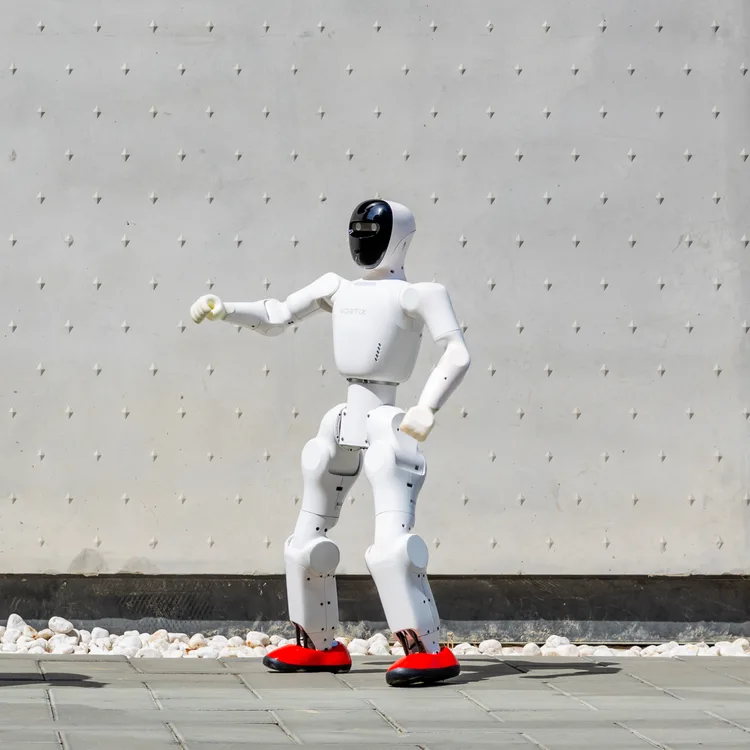
Bumi
A small walking humanoid from China, pitched at families and schools and priced far below other humanoids. It's only sold in China so far, and nobody outside the company has published a hands-on test.
See the alternatives below, or switch market.
The short version
Bumi is Noetix Robotics' consumer humanoid, a child-sized robot just under a metre tall that the maker says can walk, dance, shake hands and respond to spoken commands. It's aimed at families, schools and people starting out in robotics. You can program it by dragging and dropping blocks in an app, and developers get an open motion-control interface. Noetix also makes larger research humanoids, the N2 and E1, which Bumi sits below.
What made it news is the price, a fraction of what other walking humanoids cost. The catch is that it's sold in China, and there's no official way to buy one in the UK, Europe, the US or Australia. Importing one would mean no local support, possibly Chinese-language software and no independent evidence of how well it works.
There are standard Lite and Pro versions and three education versions with extra computing power.
Our take: For now, Bumi is one to watch rather than buy. If you want a small humanoid you can buy outside China, Unitree's R1 and Booster's K1 are the nearest options, though both cost several times more and are aimed at developers. If the goal is teaching a child to program a walking robot, a small robot dog kit does that today for much less.
Where it sits in Noetix’s range
- BumiThis model
- Noetix N2Larger bipedal humanoid built for agility
- Noetix E1Bipedal humanoid above Bumi
What we know so far
Limited evidence No independent, finished hands-on review of this robot yet. What follows comes from the maker's specifications and early coverage, and says where something is untested.
Nobody independent has reviewed Bumi yet, and we couldn't find a hands-on video we could verify. The only coverage we could read is news: Gizmochina on the supply deal and sales start, and Aparobot on the launch and how it compares with Noetix's N2. Both only repeat what Noetix says it can do. Treat every capability on this page as a manufacturer claim until someone tests it.
A humanoid at a toy-like price
Gizmochina called Bumi the world's cheapest humanoid, far below Tesla's expected Optimus price or Agility's Digit. Aparobot says it undercuts the next cheapest small humanoids, such as Booster's K1 and Unitree's R1, several times over. That's the whole story so far. Price alone doesn't tell you how well it walks, how long it lasts or how often it falls, and no published test has answered those questions yet.
Built for learning, not chores
According to Gizmochina, Bumi can walk, run, dance and respond to voice commands, and it's programmed with simple drag-and-drop tools. It's aimed at children, schools and robotics beginners. Aparobot adds that developers get an open programming interface. Nothing suggests it can tidy up, fetch things or help around the house. Think of it as an educational robot that happens to be shaped like a person.
Specs have changed since launch
At launch, Aparobot reported a height of 940mm and a weight of 12kg. Noetix's own page now lists 98cm and about 17kg, with 21 joints and a claimed two to three hours of running time, per the specifications. Nobody has explained the difference; the design may simply have changed before sales began. Check the exact version and its specifications with the seller before paying.
Hard to buy outside China
Sales were due to start in China in January 2026, per Gizmochina, which also reported a deal for 1,000 units to go to a Chinese company. Aparobot says 300 were sold when it was announced. We found no official seller for the UK, Europe, the US or Australia. Buying through an importer means paying shipping and duties, and having nobody local to fix it.
No independent reviews found. Specs come from Noetix's product page and cover the Lite, Pro and EDU versions, which share the same body.
Before you buy
The questions people ask about this one
Can I actually buy one?
Only in China, as far as we can tell. Gizmochina reported sales starting there in January 2026. There's no official seller in the UK, Europe, the US or Australia, so you'd have to import one through a reseller and accept the risks that brings.
What can it do on its own today?
Noetix lists voice-triggered moves such as standing up, waving, shaking hands, high fives, walking and dancing, and it stands up and lies down by itself, per the specifications. Gizmochina adds drag-and-drop programming. Nobody independent has checked how reliably it does any of that.
What does it need to run?
A charged battery and the phone app. Noetix fits a quick-release battery and claims two to three hours of running time, with Wi-Fi and Bluetooth, per the specifications. Two of the education versions add a more powerful computer. Charging time and any account requirements aren't published in English.
Who supports it if it breaks?
Outside China, probably nobody. Gizmochina describes sales in China only, and we found no overseas service partner. If you import one, assume repairs mean shipping it back or fixing it yourself.
Compare with
R1
A small humanoid from a maker that sells internationally, with development options if you want to go further.
It's a robotics project for a technical owner, and the starting version lacks much of what the demos show.
K1
A compact humanoid built for robotics teaching, competitions and writing your own behaviours.
The versions differ a lot, and nothing shows it's ready to help at home.
Full specifications
Figures come from the manufacturer’s product page unless a source is named. A blank means nobody we trust has confirmed it.
Owner reviews
Own a Bumi?
Tell people how it’s held up: cleaning, maintenance, faults and support. Owner reviews are shown separately from expert tests and never mixed into the score.
Sources
Everything cited on this page. Expert scores are shown as the reviewer gave them.