
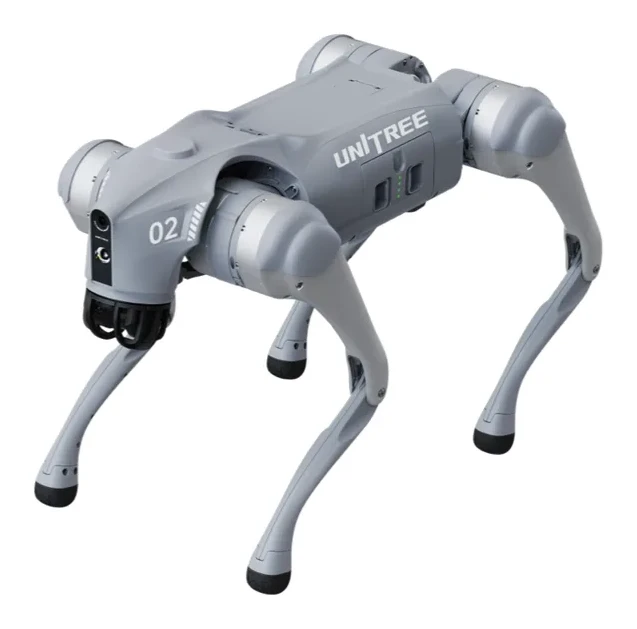
Go2 (Air / Pro)
Review coverage: two Go2 Pro reviews and one Go2 teardown with its variant unspecifiedRead the findings →Unitree's spaniel-sized robot dog, replacing the Go1 and built for robotics hobbyists. It's brilliant at walking over rough and uneven ground. Once the novelty fades, it's short on practical uses, and stairs can trip it up.
Updated
Check the manufacturer’s site for current availability.
Where it sits in Unitree’s range
- Unitree Go1The 2021 model it replaced
- Go2 (Air / Pro)This model
- Unitree Go2 EDUDeveloper version with bigger battery and full access
- R1Unitree's small humanoid
- Unitree B2Large industrial robot dog
Feedback
What reviewers found
Three looks at the Go2 so far: New Atlas and FauxHammer lived with the Pro, and iFixit took one apart and tested it on stairs. Everyone agrees it moves impressively and is fun, and both home reviewers struggled to say what it's for. All three found it capable once moving but not foolproof: it fell down steps for New Atlas, cracked its neck on stairs for iFixit, and dodged obstacles clumsily for FauxHammer. Neither home reviewer found the voice features dependable.
New Atlas, hands-on, May 2025 (tested on the Go2 Pro) · FauxHammer, hands-on, Jun 2026 (tested on the Go2 Pro) · iFixit, hands-on
What it really does
Mixed resultsIt moves as well as promised on rough ground once walking, per FauxHammer and New Atlas. The extras fall short: it fell down steps for New Atlas, iFixit found it only sort of handles stairs, and FauxHammer found voice commands and obstacle avoidance unreliable.
Staying engaging
Mixed resultsBoth home reviewers had fun, but doubt it lasts. New Atlas says marching it up and down the street is fun for a while and urges buyers to think about what comes after the tricks, and FauxHammer struggled to say what it's for.
Who it suits
Mixed resultsIt suits hobbyists who want a head-turning gadget, not anyone after a pet, guard or helper. New Atlas found no practical job for it, and FauxHammer warns it's heavy and fast enough to clip ankles around children.
App, subscription and running costs
Mixed resultsThe app offers detailed controls but takes time to learn. New Atlas found the video-only instructions difficult to follow while operating the robot. FauxHammer liked the live camera and mapping, while also finding the interface less approachable than a typical consumer app.
Privacy
Not enough evidenceNo qualifying review looked at what its camera and LiDAR record or where the data goes.
Build quality and battery life
Mixed resultsiFixit found it fairly modular, with a hand-swappable battery, but its unit cracked inside the neck during stair tests. New Atlas and FauxHammer both scuffed the knees on concrete, and FauxHammer got about two hours per charge.
Support and longevity
Not enough evidenceOnly iFixit looked at repairs, finding it couldn't order legs or motors directly, just a contact form. No qualifying review judged Unitree's support over time.
Value
Mixed resultsiFixit calls it surprisingly affordable next to research robots such as Spot. New Atlas says it's excellent at what it does but warns buyers to think hard about its use before spending around $3,000.
Verdicts come from independent, hands-on, finished reviews. An area needs at least two of them before we say more than “Not enough evidence”. We don't score robots ourselves. How this works
Brilliant body, unclear purpose
New Atlas summed it up as fun on four legs but in need of a purpose, and told readers to think hard about what they'll do once the tricks get old. FauxHammer called it "not a sensible appliance purchase" while also rating it one of the coolest consumer gadgets around. So buy it as a hobby or a talking point. If you're hoping it will guard the house, fetch things or keep you company, neither reviewer found it doing that.
Rough ground: good once it's moving
FauxHammer reported good movement on grassy slopes, dirt trails and uneven paths. New Atlas also liked how it handled rough ground once walking, but found it needed a flat, smooth surface to start up. Stairs were shakier: New Atlas had it fall down front steps, and iFixit found stair handling limited. Stick to Unitree’s operating limits and a clear space, and don't take a few good climbs as proof your stairs are safe.
It takes practice to drive
New Atlas called learning to operate it "initially a daunting task" and ended up pausing the app's videos to take notes. FauxHammer liked what the app can show, including the live camera and a map of the space, but described it as "engineering-first, UX-later". Both say start-up needs care: lay it out properly on stable ground. When it fell while standing up for New Atlas, its legs thrashed until the tester reached in and pressed the power button.
Voice and obstacle dodging are patchy
The Pro can take spoken commands, but FauxHammer found activation and recognition inconsistent and the replies "functional rather than characterful". Its obstacle avoidance was "overcautious or confused" in cluttered spaces, which also made it take odd routes in follow mode. New Atlas got the follow-me remote working and could steer it with leash pulls. Treat these as party tricks rather than reasons to choose the Pro over the Air.
Repairable, but it will get marked
iFixit found the battery easy to swap by hand and the design fairly modular, with plastic collars at the hips meant to break before the joints do. But it couldn't order legs or motors directly, just a contact form, and the sensor in its chin is buried deep. Its unit cracked inside the neck during stair testing. New Atlas and FauxHammer both scuffed the knees on concrete. Expect wear, and ask your seller about repairs before you buy.
New Atlas and FauxHammer used the Go2 Pro; iFixit doesn't say which version it took apart. The Air is slower and lacks voice and the follow remote; the X and EDU are developer models.
Our take
Should you buy the Go2 (Air / Pro)?
Best for: Robotics enthusiasts interested in a walking robot dog. Skip it if: You expect it to do household chores by itself.
Consider the Go2 as a robotics hobby, with time set aside to learn its controls and limits. The Pro reviews do not establish that its voice and follow features alone justify the upgrade from Air. Compare the exact hardware and programming access before choosing a variant; for a pet-like companion or a smaller coding project, other types of robot may be a better fit.
The Go2 is Unitree's small four-legged robot and the replacement for the Go1. It is about the size of a spaniel, weighs around 15kg, and walks, trots, climbs kerbs and does tricks such as handstands. The Air is the entry model, the Pro adds a follow-me remote, voice features and a faster top speed, and the X and EDU are for developers. The Air and Pro only get simple block-style programming.
Everyone agrees it moves impressively. FauxHammer took it up grassy slopes and dirt trails and was impressed by how it coped, and New Atlas found kerbs and uneven surfaces no problem once it was walking, though it had to start from flat ground. Stairs are the weak spot: New Atlas saw it fall down its front steps, and iFixit's unit cracked inside the neck during stair tests. FauxHammer found voice commands inconsistent and obstacle avoidance overcautious or confused in cluttered spaces. Both home reviewers struggled to say what it is for, and New Atlas told buyers to think hard about what comes after the tricks. iFixit found the battery easy to swap but could not order legs or motors directly, and both New Atlas and FauxHammer scuffed the knees on concrete.
Where to buy
Where to buy the Go2 (Air / Pro) in United Kingdom
No United Kingdom price checked in the last 21 days. We re-check daily.
We’re still looking for more United Kingdom retailers for this model.
Price-drop alert
Get an email when the Unitree Go2 (Air / Pro) gets cheaper in the UK.
Before you buy
The questions people ask about this one
Is it a toy, a pet or a development platform?
Closest to an expensive toy. Neither New Atlas nor FauxHammer found a practical job for the Pro beyond showing it off, and it doesn't bond with you like a pet robot. Deeper programming is only on the X and EDU, per the specifications.
Can it go outside and up stairs?
Outside, yes. FauxHammer walked it on grassy slopes and dirt trails, though New Atlas needed flat ground to start it. Stairs are less reliable: it fell down steps for New Atlas, and iFixit found internal damage after stair testing. Unitree claims the Pro climbs about 16cm, per the specifications.
How long does the battery last?
Unitree says one to two hours on the Air, Pro and X, per the specifications, and FauxHammer got about two hours, less in the fast mode. The battery comes out by hand, as iFixit found, so a spare extends your time out. The EDU's bigger battery is claimed to last two to four hours.
Can I program it?
A little. All versions get graphical programming, per the specifications, and New Atlas built simple drag-and-drop routines in the app and walked it back to points on a map. Proper development access is limited to the X and EDU. If learning to code a walking robot is the goal, a cheaper kit is a better start.
Is it safe around children and pets?
None of the reviews shows it's safe around children or pets. FauxHammer and New Atlas describe a heavy, fast-moving machine with powered joints that can hit, scratch or pinch, and watching it closely doesn't remove that. Follow the manufacturer’s operating restrictions and keep people well clear of the moving parts.
What does it cost to repair?
iFixit found the battery and legs fairly easy to get at and replace, but couldn't order legs or motors directly when it did its teardown. Unitree lists some accessories and batteries. Before buying, ask the seller how damaged joints or motors get repaired, which parts it supplies and what warranty covers your exact version and region.
Alternatives
Other robot dogs to compare.

aibo ERS-1000
Why consider it: It's a robot pet first: owners love its autonomous play, ball games and the personality it develops.
The compromise: Many settings depend on Sony's cloud plan, and a second-hand one needs an account transfer.
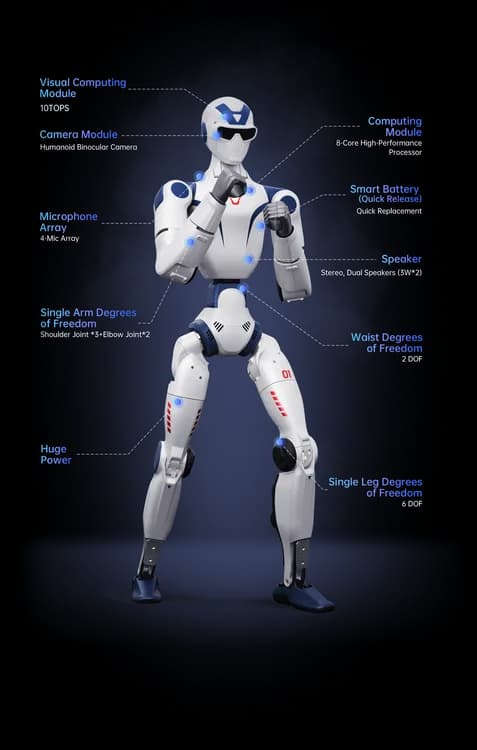
R1
Why consider it: Unitree's small humanoid is another way into walking robots, with development options if you want to go further.
The compromise: It's a robotics project that needs a technical owner, and the starting version lacks much of what the demos show.
Specs
Full specifications
Each specification names its source. Manufacturer claims are not independent test results; unconfirmed figures are labelled.
Owner reviews
Do you own the Go2 (Air / Pro)?
Tell people how it has held up: movement, controls, battery life, faults, repairs and how you use it. Owner accounts are shown separately from independent reviews.
Sources
Where this page’s findings come from
Editorial reviews
- New Atlas: Review: Unitree Go2 Pro robot is fun on four legs – but it needs a purpose in life ↗Hands-on · Tested on the Go2 Pro
- FauxHammer: UniTree Go 2 Pro review: what's the point of a robot dog, really? ↗Hands-on · Tested on the Go2 Pro
- iFixit: Unitree Go2 teardown and repairability ↗Hands-on
Sources
- Unitree: Go2 product specifications ↗Manufacturer
- Unitree shop: Go2 store page and spare parts ↗Manufacturer
Videos
- Search YouTube for Unitree Go2 (Air / Pro) ↗Search results may include company demonstrations or similar models. Check the source and model name; a demonstration is not an independent performance test.