
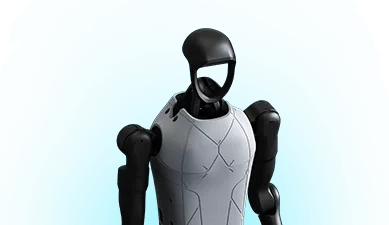
H1-2
Limited evidenceRead the findings →The heavier, stronger-armed version of Unitree's full-size humanoid, for research and industry. It's for labs and companies with engineers to program it. It's sold only through Unitree's sales team, with no published price.
See the alternatives below, or switch market.
Where it sits in Unitree’s range
Feedback
What we know
What's here comes from Unitree's shared H1 and H1-2 spec page Unitree and from developer documentation published by Weston Robot, a distributor that supplies and supports the robot, so that isn't independent either. We found no hands-on coverage, so nobody has yet checked how it grips and carries, whether the extra ankle joint helps its balance, or the payload, speed and battery figures, which are the maker's claims.
Stronger arms than the H1
The arms are the big change from the H1. According to Unitree, each one has seven joints: three at the shoulder, one at the elbow and three at the wrist. Unitree rates them at about 7kg in normal use and about 21kg at peak, and five-fingered hands are an option. The original H1 has four-joint arms and no published payload.
Slower, heavier, steadier on its feet
H1-2 weighs about 70kg against the H1's 47kg, and Unitree quotes a moving speed under 2m/s, well down on the H1's claimed 3.3m/s. Each leg gets a second ankle joint, which should help balance and posture. The head-mounted laser scanner and depth camera carry over from the H1. Weston Robot warns that at 180cm it can do real damage to itself and its surroundings if it falls.
You write the software
Weston Robot describes H1-2 as a development platform. Unitree's own software handles walking, and you write your application on top of it over the robot's internal network, with a wired connection for anything touching low-level control. One onboard computer is reserved for Unitree's movement software and one or two are yours, per Unitree. There's no consumer app here, so plan on having an engineering team.
Specs come from Unitree's shared H1 and H1-2 page; the figures quoted here are for the H1-2.
Our take
Should you buy the H1-2?
Best for: Research teams with engineers to program a full-size humanoid. Skip it if: You expect it to do household chores by itself.
H1-2 is for research groups and companies that want a full-size humanoid with arms strong enough for handling experiments, and engineers to program it. It isn't for homes, and it isn't something you can simply order. If you want Unitree's newest full-size design with a store listing, look at the H2. If speed matters more than arms, the original H1 is quicker, and a G1 is far easier to live with in a lab.
H1-2 is an upgraded H1. It stands about 1.78m tall and weighs about 70kg, far more than the 47kg original. The extra weight buys better arms and legs: seven joints in each arm instead of four, ankles with two joints, and optional five-fingered hands. Unitree rates each arm at about 7kg in normal use and about 21kg at peak.
The trade-off is that it gives up the H1's headline speed. Unitree quotes under 2m/s, against 3.3m/s for the H1. There's also no store listing. Unitree publishes no price for it, so every sale goes through its sales team. A distributor's documentation describes it as a development platform that you program yourself over the robot's internal network.
The newer H2 is similar in size and weight and adds a sculpted face.
Before you buy
The questions people ask about this one
Can I actually buy one?
Only through Unitree's sales team or a distributor. Unitree publishes no price and its store has no separate H1-2 listing, though distributors such as Weston Robot supply and support it. Expect a quote rather than a checkout.
What can it do on its own today?
Walk, balance and sense its surroundings using Unitree's own control software, per the specifications. Everything else, including using the arms for work, is for your developers to build. Weston Robot points developers to Unitree's example code as a starting point.
Is it safe to have around people?
It's a 70kg, 1.78m robot, and Weston Robot says a fall can do real damage to the robot and whatever's around it. The distributor tells owners to read its safety guidance before powering it on for the first time. Nobody has published a safety test.
What does it need to run?
A charged 864Wh battery, a wired network connection for low-level control, and people who can program it Weston Robot. Unitree doesn't give a running time for H1-2 the specifications.
Alternatives
Other humanoid robots to compare.
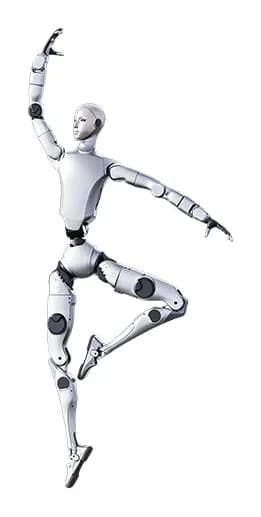
H2
Why consider it: Unitree's newer full-size humanoid, with a similar rated arm load and a store listing.
The compromise: Programming it needs the EDU version, and nobody independent has tested it.
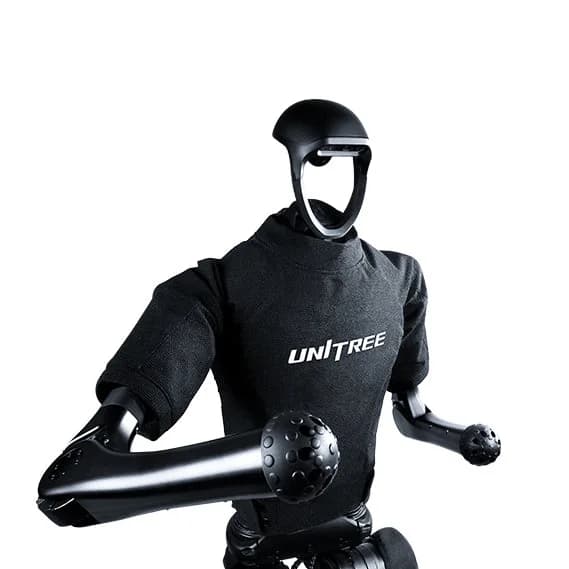
H1
Why consider it: The lighter, faster original, if movement research matters more than handling.
The compromise: Its four-joint arms are far weaker, and the store asks you to contact sales for the real price.

Walker S2
Why consider it: An industrial humanoid that swaps its own battery and handles loads.
The compromise: It's aimed at factories rather than labs, and it isn't sold to individuals.
Specs
Full specifications
Each specification names its source. Manufacturer claims are not independent test results; unconfirmed figures are labelled.
Owner reviews
Do you own the H1-2?
Tell people how it’s held up: cleaning, maintenance, faults and support. Owner accounts are shown separately from independent reviews.
Sources
Where this page’s findings come from
Sources
Videos
- Search YouTube for Unitree H1-2 ↗Search results may include company demonstrations or similar models. Check the source and model name; a demonstration is not an independent performance test.